

close
Choose Your Site
Global
Social Media
Views: 0 Author: Site Editor Publish Time: 2023-11-20 Origin: Site
You want perfect pastries every time, right? Baking oven basics make a huge difference. When you know your oven, you control texture and rise. Check out these findings:
| Study | What Happens |
|---|---|
| Le-Bail et al. | More steam increases volume, makes crust thinner. |
| Park & Baik | Lower temperature, longer time softens crumb. |
Try these baking tips. Use steam and temperature tricks. Baking tips help you master baking oven basics. You’ll get better results with these tips.
Know what kind of oven you have. Use convection ovens to make pastries crispy. Use conventional ovens to bake soft cakes.
Always turn on your oven early to preheat for 20-30 minutes. This makes sure your food bakes evenly. It also helps pastries rise the right way.
Use an oven thermometer to see the real temperature. This stops you from baking your pastries too much or too little.
Image Source: pexels
You may wonder which oven is best for pastries. Let’s look at how they work. Conventional ovens heat from the top and bottom. You need to turn pans so everything bakes evenly. Convection ovens use a fan to move hot air. This helps pastries bake faster and more evenly.
Here’s a simple comparison:
| Performance Metric | Conventional Oven | Convection Oven |
|---|---|---|
| Cooking Speed | Slower | Up to 25% faster |
| Temperature | Hot and cold spots | Consistent temperature |
| Evenness | Rotate pans needed | Even results, no rotation |
| Browning | Sometimes uneven | Superior browning and crisping |
Convection ovens help pastries get golden and crisp. The moving air takes away moisture from the top. This is good for cookies and croissants. If you want soft cakes or gentle pastries, use a conventional oven. It gives soft heat that helps them rise and not fall.
Tip: Use convection for crispy, golden pastries. Use conventional for soft, fluffy treats.
When picking an oven, look for features that help you bake well. Convection ovens give even heat and steady temperatures. Some ovens have steam injection. This keeps dough moist and makes a thin, shiny crust.
Here are features pastry chefs like:
Even heat for baking everything the same.
Steam injection for moist dough.
Stable temperature for good results.
Think about what you bake most. If you make lots of bread or pastries, get an oven with steam and good controls. Always check the size and energy use. The right oven features make baking easier and more reliable.
You want your pastries to turn out just right, so you need to pay attention to temperature. Many home ovens can be off by 25-50°F from the set temperature. Sometimes, the difference can reach 90 degrees. A small change of 10-15 degrees is usually fine, but bigger gaps can ruin your baking. Built-in oven displays often show the wrong temperature. You might notice that the corners of your oven get much hotter than the center. This can make your pastries bake unevenly.
Tip: Always preheat your oven before baking. This helps you get a steady temperature and better results.
Oven thermometers help you with temperature control. They give you a true reading of the heat inside your oven. Here’s how you can use one:
Place a rack in the middle of your oven.
Put the thermometer in the center.
Set your oven to 350°F and let it heat for 30 minutes.
Check the thermometer and write down the temperature.
Repeat a few times and average the results.
Oven thermometers help you avoid over-browning and undercooked centers. You get pastries with perfect texture and crispy layers. You can adjust your baking time based on what the thermometer shows.
Your oven has different settings for baking. The bake function uses heat from the top and bottom. This gives you even cooking and rich flavors. Broil sends strong heat from above. It helps you get a golden, crisp top on pastries fast. Baking lets the Maillard reaction and caramelization happen. These reactions make your pastries brown, sweet, and full of flavor.
The Maillard reaction gives your crust a deep color and tasty aroma.
Caramelization makes sugars turn golden and adds sweetness.
Try different settings to see how they change your pastries. You’ll learn which ones give you the best results.
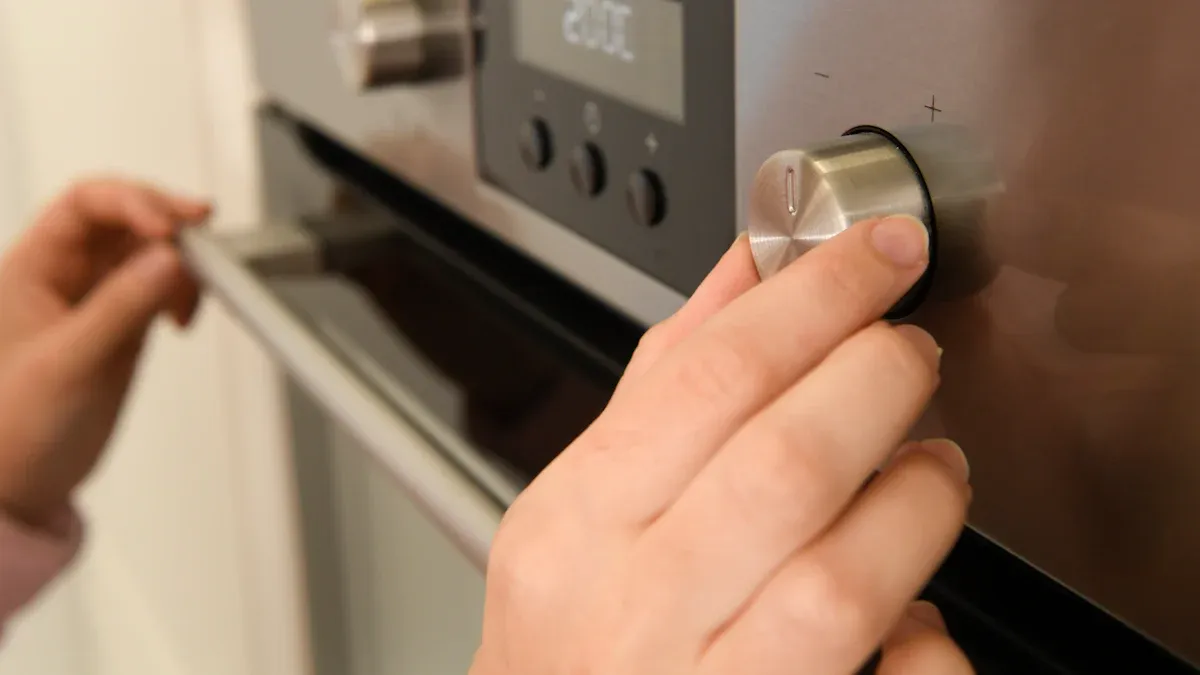
Image Source: pexels
You want your pastries to bake well. Preheating your oven is very important. Most ovens need 20 to 30 minutes to get hot enough. This steady heat helps leavening agents work. Your pastries puff up and get the right texture. If you do not preheat, pastries can turn out flat or heavy. The right temperature starts the Maillard reaction. This makes pastries golden and tasty.
Preheat your oven for 20–30 minutes before baking.
Preheating is needed for delicate pastries to get the right texture.
Steady heat helps pastries rise and bake all the way through.
Where you put your tray matters a lot. The middle rack gives even heat. If you use a higher rack, pastries cook and crisp faster. The lower rack makes pastries softer. The middle rack is best for most pastries. It balances heat from the top and bottom. Always look at your oven’s heating elements to choose the best rack.
Middle rack means even cooking.
Higher rack cooks and crisps faster.
Lower rack gives a softer texture.
The bakeware you pick changes how your pastries turn out. Some materials hold heat better. Others help pastries come out easily. Here is a simple guide:
| Type of Bakeware | Suitable Pastry Types |
|---|---|
| Ceramic and Stoneware | Good for pies, tarts, and dishes. They keep heat well and look nice for serving. |
| Silicone | Great for muffins and baking mats. Pastries come out easily and heat spreads evenly. |
| Non-Stick | Best for soft cakes and muffins. Pastries do not stick and cleanup is easy. |
Glass pans heat up slowly. You may need to lower the temperature. Silicone can keep heat in, so pastries may not bake enough. Metal pans help cookies brown better. Choose bakeware based on what you want to bake and how you want it to look.
You might wonder why some pastries turn out light and airy while others feel dense or dry. The secret often comes down to how your oven spreads heat. If your oven heats unevenly, you can get pastries with tough edges or soggy centers. When you understand heat distribution, you can make better choices for baking.
Let’s look at how temperature affects moisture and rise. Here’s a table that shows what happens inside your oven:
| Temperature (°C) | Moisture Loss (%) | Volumetric Expansion (%) |
|---|---|---|
| 180 | 11 | 27.6 |
| 200 | 15 | 23 |
| 220 | 17 | 23.5 |
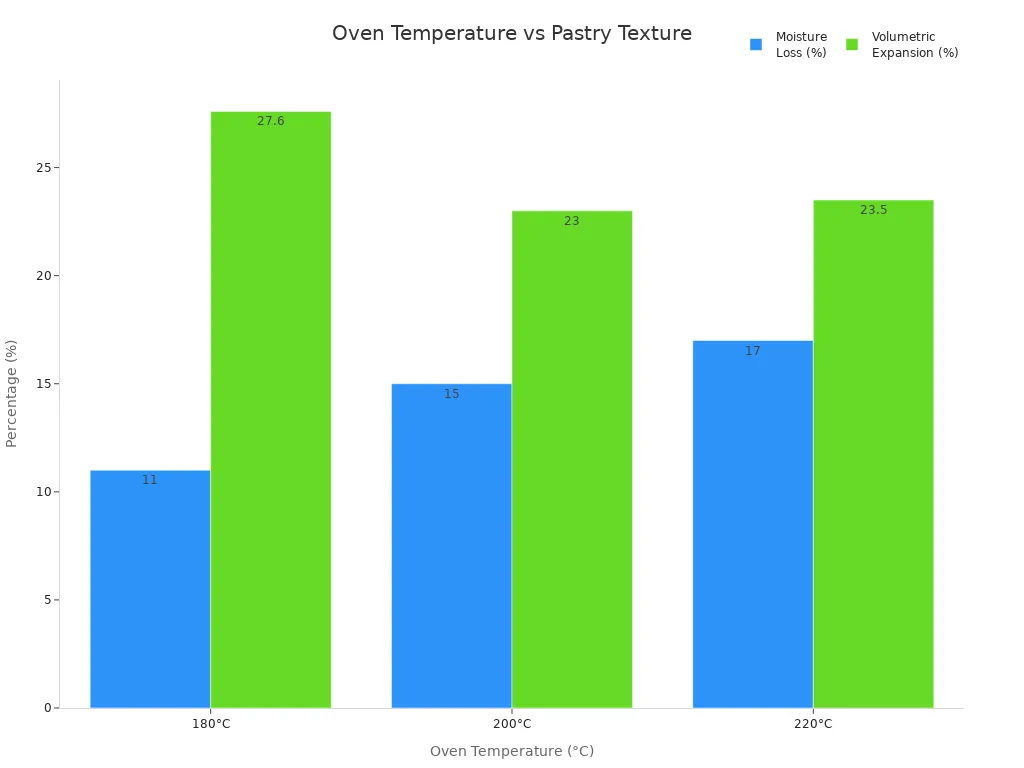
If you bake at a lower temperature, your pastries lose less moisture and expand more. This means you get a softer crumb and a lighter texture. Higher temperatures make pastries lose more water, so they turn out drier and sometimes shrink. You want to find the right balance for your favorite cakes and pastries.
Professional bakers use a few tricks to keep heat even:
Thermal profiling helps you spot hot and cold zones in your oven.
Airflow control lets you move air around, so pastries bake evenly.
Energy transfer optimization means you adjust settings to use heat better.
You can try these tips at home:
Move your oven racks to different positions for better results.
Check your oven door seal to keep heat inside.
Calibrate your oven often to match the set temperature.
Tip: If you notice uneven browning or raw spots, rotate your pans halfway through bake time. This helps you get flawless cakes and pastries every time.
You want to pull your pastries out at the perfect moment. If you take them out too soon, they might collapse or taste raw. If you leave them in too long, they get dry and tough. So, how do you know when your cakes and pastries are done?
Culinary experts say you should check the internal temperature. Christopher Kimball recommends using a thermometer instead of just looking at color or poking the pastry. King Arthur Baking suggests you use a mix of visual cues, texture, and temperature checks.
Here’s a table to help you know when your pastries and cakes are ready:
| Pastry Type | Doneness Temperature (°F) | Doneness Temperature (°C) |
|---|---|---|
| Regular Cake | 200–209 | 93–98 |
| Custards (e.g., crème brûlée) | 170–175 | 77–79 |
You can use a digital thermometer to check the center. For cakes, look for a golden top and a springy feel. For custards, the center should jiggle slightly but not be liquid. If you follow these steps, you’ll get perfect pastries every time.
Note: Always check doneness a few minutes before the suggested bake time ends. Ovens can run hot or cold, so your pastries might finish early or need a little longer.
You can also use these signs:
The edges pull away from the pan.
A toothpick comes out clean from the center.
The top feels firm and springs back when touched.
If you use these methods, you’ll get consistent results and avoid underbaked or overbaked pastries. You’ll feel confident every time you bake cakes or pastries for friends and family.
You might notice your pastries bake unevenly. This happens for a few reasons:
The convection fan or motor does not work right, so air does not move well.
You place racks in the wrong spot, which changes how heat spreads.
Heating elements wear out, causing hot and cold spots.
The oven thermostat or thermistor can break, making the temperature jump around.
You can fix uneven baking by checking your oven parts. Make sure the fan spins and the heating elements glow. Place your pans on the middle rack for the best heat. If you see one side browning faster, rotate your pan halfway through baking.
"Ovens can have hot spots, which can be a big contributor to uneven baking and browning if the pan isn't rotated."
Here are some quick fixes for hot spots:
Use the middle rack for even heat.
Rotate your pans during baking.
Check your oven temperature with a thermometer.
Pick light-colored pans for even browning.
Keep the oven door closed to hold in heat.
These steps help you get pastries that look and taste great.
Baking at high altitudes or in humid places can change your results. At high altitudes, air pressure drops. Pastries rise fast and can fall if they do not set. Liquids evaporate quickly, so pastries dry out. Water boils at lower temperatures, so baking goes faster.
Try these tips:
Raise oven temperature by 15–25°F above 3,500 feet.
Add 1–2 tablespoons of liquid at 3,000 feet, and more for higher places.
Add 1 tablespoon of flour at 3,500 feet, and more as you go higher.
In dry air, add extra liquid. In humid air, use less flour.
These changes help your pastries rise and stay moist, no matter where you bake.
You might think your pastries are done once they leave the oven, but cooling is just as important as baking. If you rush this step, you can ruin the texture and taste. Here are some cooling tips pastry chefs use to keep pastries crisp and delicious:
Let pastries cool on wire racks so air can move around them. This stops sogginess and keeps the crust flaky.
Use baking cooling tunnels if you have access. These help control moisture and keep pastries from getting soggy.
Brush pie crusts with beaten egg white or melted butter. This creates a barrier that keeps moisture out.
Sprinkle bread crumbs or use crust dust on the bottom of pies. This absorbs extra liquid and keeps the crust crisp.
Salt vegetables before adding them to pies. This draws out water and stops it from leaking into the crust.
Quick chilling helps prevent skinning and uneven layers. If you cool pastries too slowly, you might get a chewy or tough texture. The way you chill pastries affects the final layers and quality.
Tip: Never freeze hot pastries. Freezing can damage the water and fat crystals, making your pastry lose its perfect structure.
You want your pastries to look as good as they taste. Professional bakers use several techniques to make desserts stand out. Here’s a table with some popular presentation methods:
| Technique/Principle | Description |
|---|---|
| Good Basic Baking and Pastry Skills | You need solid baking skills. Neat preparation makes desserts look and taste better. |
| Professional Work Habits | Careful and tidy work shows pride and improves presentation. |
| Visual Sense | Use color, shape, and texture to balance your plate. Arrange garnishes and sauces for extra appeal. |
| Modern Plating Styles | Try creative arrangements. Move beyond simple plating to make desserts exciting. |
| Collaboration with Kitchen Chefs | Work with other chefs to match desserts with the meal and create a memorable dining experience. |
A beautiful pastry makes people want to taste it. Take your time with plating and decoration. You’ll impress your guests and enjoy your baking even more.
You can get really good at baking pastries if you learn about your oven. Try these habits to help you do well for a long time:
Always read your recipe before you begin.
Use a kitchen scale so your measurements are right.
Make a checklist for hard steps so you don’t forget anything.
Check your work as you bake to catch mistakes.
Keep practicing and try new things with your oven. You will get better each time.
You might use warm dough or too much butter. Chill your dough before baking. Use parchment paper. Measure ingredients carefully. Try baking one tray of cookies at a time.
Look for golden edges and a soft center. The cookies should feel set but not hard. Let them cool on the tray. You can check with a toothpick if needed.
Store cookies in an airtight container. Keep dough wrapped in plastic in the fridge. You can freeze dough for later. Always label your dough and cookies with the date.


